Capital Market Development in Southeast Asia: Indonesia, Philippines and Vietnam

Capital markets play an important role in mobilising long-term institutional capital and supporting economic growth. This report, commissioned by MOBILIST and produced by Fiin Ratings, examines the state of capital market development across Vietnam, Indonesia and the Philippines.
It analyses the market structures, investor bases, intermediaries and regulatory frameworks in these capital markets and identifies key barriers and opportunities for their development. The report also provides practical recommendations for policymakers, regulators, development finance institutions and market participants to help strengthen public market ecosystems and expand access to long-term capital.
A diagnostic assessment of capital markets in SouthEast Asia
Development finance can support the next phase of capital market maturation.
Over the past decade, Indonesia, the Philippines and Vietnam have made meaningful progress in modernising market infrastructure, strengthening regulation and expanding the capital markets. Yet public markets still play a limited role in providing alternative sources of long-term financing.
Across all three countries, companies remain heavily dependent on bank financing. Institutional investor participation is limited or concentrated in conservative assets, issuer bases remain narrow, and secondary-market liquidity is underdeveloped. These constraints reduce the capacity of equity and corporate bond markets to finance infrastructure, climate investment and sustainable economic growth.
Building on this progress, development finance institutions have significant opportunities to support the next phase of market maturation through targeted interventions in credit enhancement, issuer readiness, and institutional investor development.

MOBILIST and FiinGroup launched the research at an event in Hanoi, with a discussion on developing public products for capital market development.
Philippines
The Philippines has an established regulatory framework but faces particularly low turnover and a narrow pipeline of public market issuers.

Market Landscape & Activity
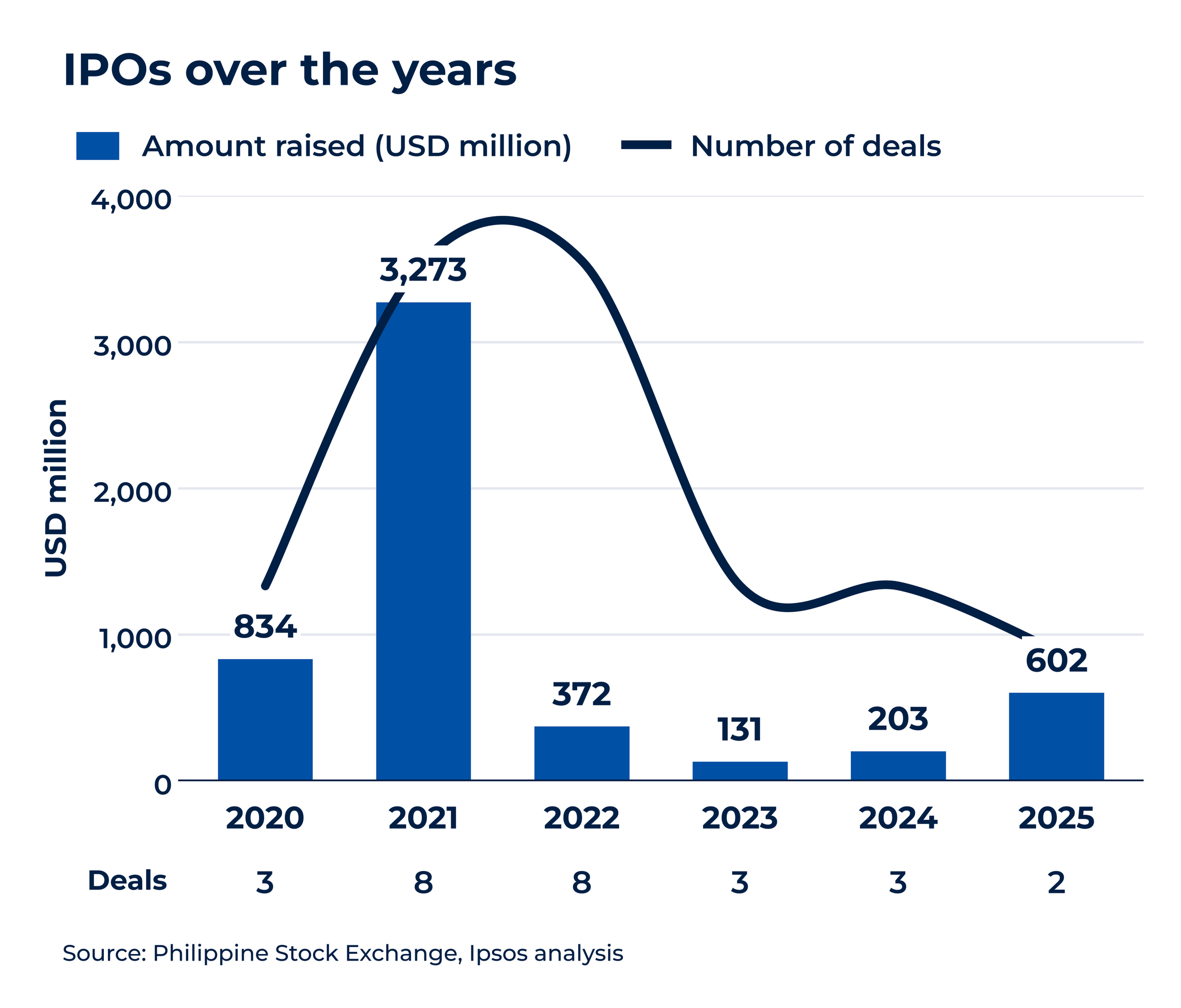
The Philippines has an established capital market framework, but remains a structurally bank-first economy and its public markets are shallow relative to the size of the economy. Equity market activity is characterised by low turnover, a limited pipeline of new public offerings and significant concentration among large family-controlled conglomerates. Only two IPOs were completed in 2025, and daily trading value fell from around USD 152 million in 2020 to around USD 132 million in 2025. The corporate bond market is similarly concentrated among large, highly rated issuers, while limited secondary trading and the absence of executable pricing benchmarks constrain liquidity and price discovery. A notable bright spot is sustainable finance: outstanding sustainable bonds reached USD 16 billion at end-2025, up 42% year on year.
Investor Landscape
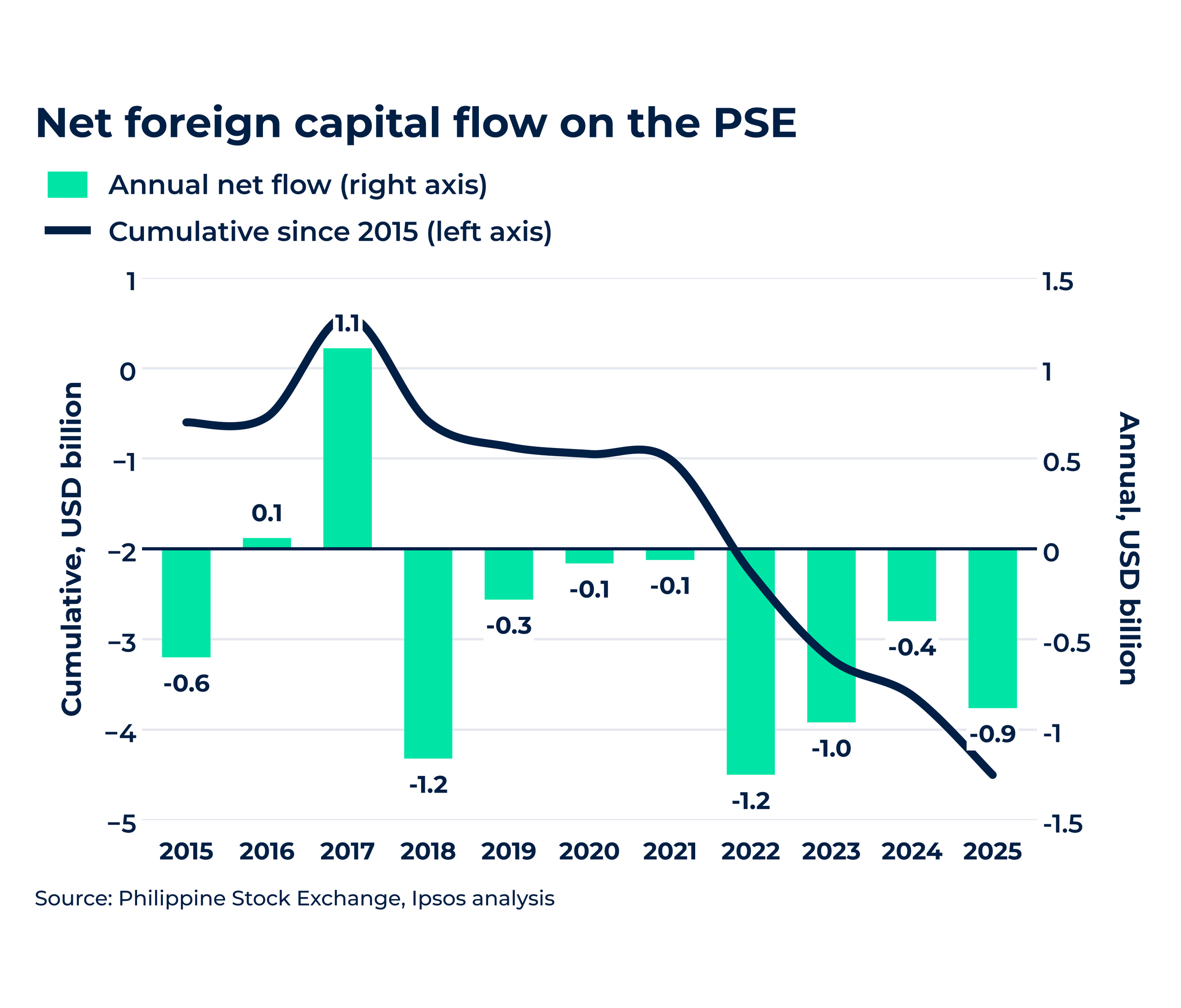
The Philippines has a significant pool of long-term domestic capital, including pension funds, insurers and bank trust entities. However, much of this capital is concentrated in government securities and other low-risk assets. Risk-based capital rules, conservative investment mandates and the limited supply of suitable instruments restrict institutional investment in a broader range of equities and corporate bonds. Ownership is dominated by family conglomerates, with corporations holding 47% of market capitalisation. Foreign investors drive trading despite their small ownership share, accounting for 46.3% of equity trading value in 2025, which leaves market liquidity sensitive to external capital flows.
Intermediaries & Market infrastructure
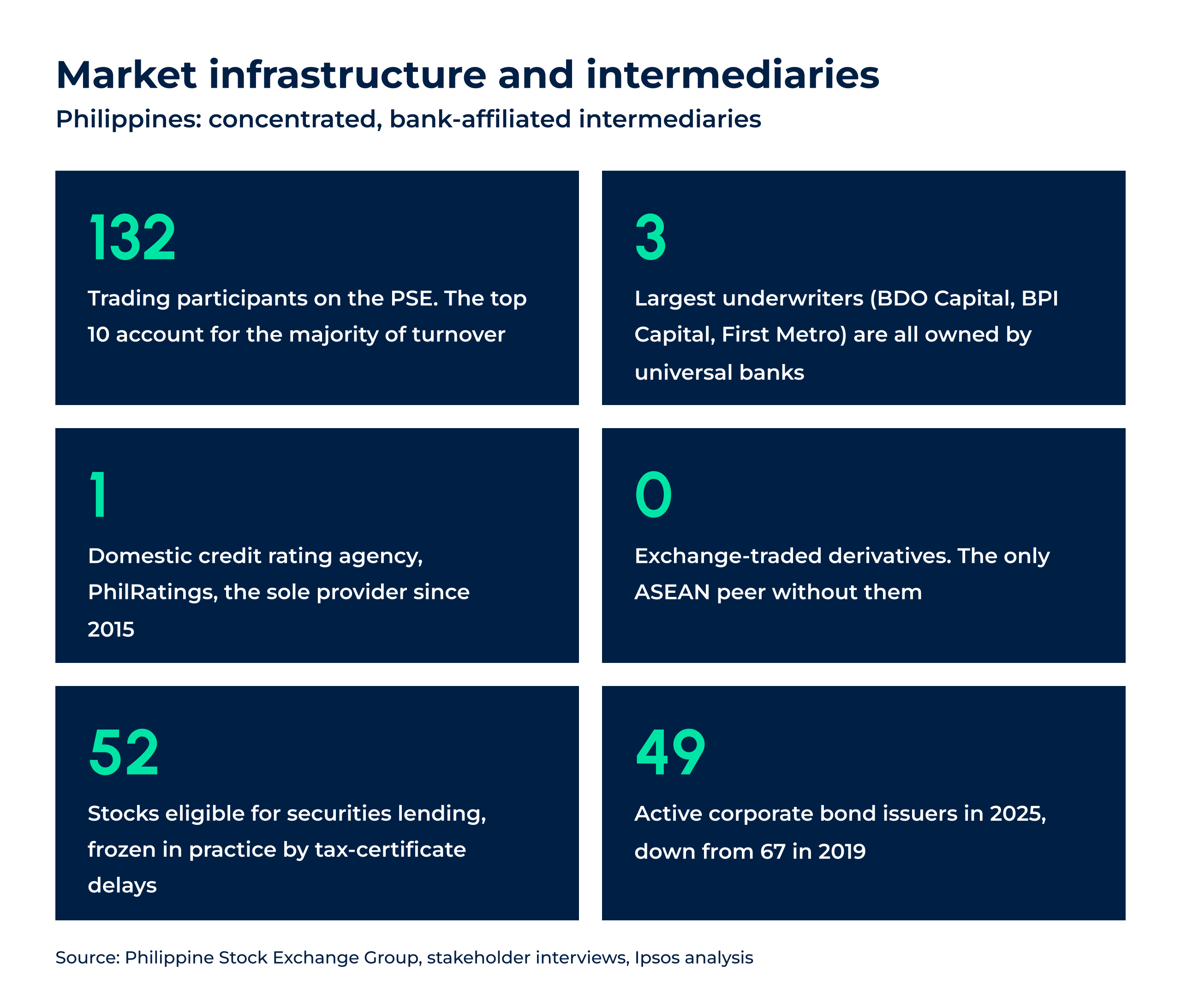
The Philippines has established exchanges, intermediaries and core systems for trading, clearing, settlement and disclosure. However, intermediary activity is concentrated among a small number of bank-affiliated firms, with research and transaction support focused primarily on large companies. Limited market-making, repo activity, securities lending and hedging instruments contribute to weak secondary market liquidity, particularly in corporate bonds and securities outside the largest listed companies.
13.%
Equity market turnover ratio in 2025 (value traded as a share of market capitalisation), the lowest of the three markets.
2
IPOs completed on the Philippine Stock Exchange in 2025. The exchange is targeting around four in 2026.
46.3%
Foreign investors' share of equity trading value in 2025, despite a small share of ownership.
Vietnam
Vietnam combines comparatively high equity market turnover with strong retail participation, but institutional participation remains limited.

Market Landscape & Activity
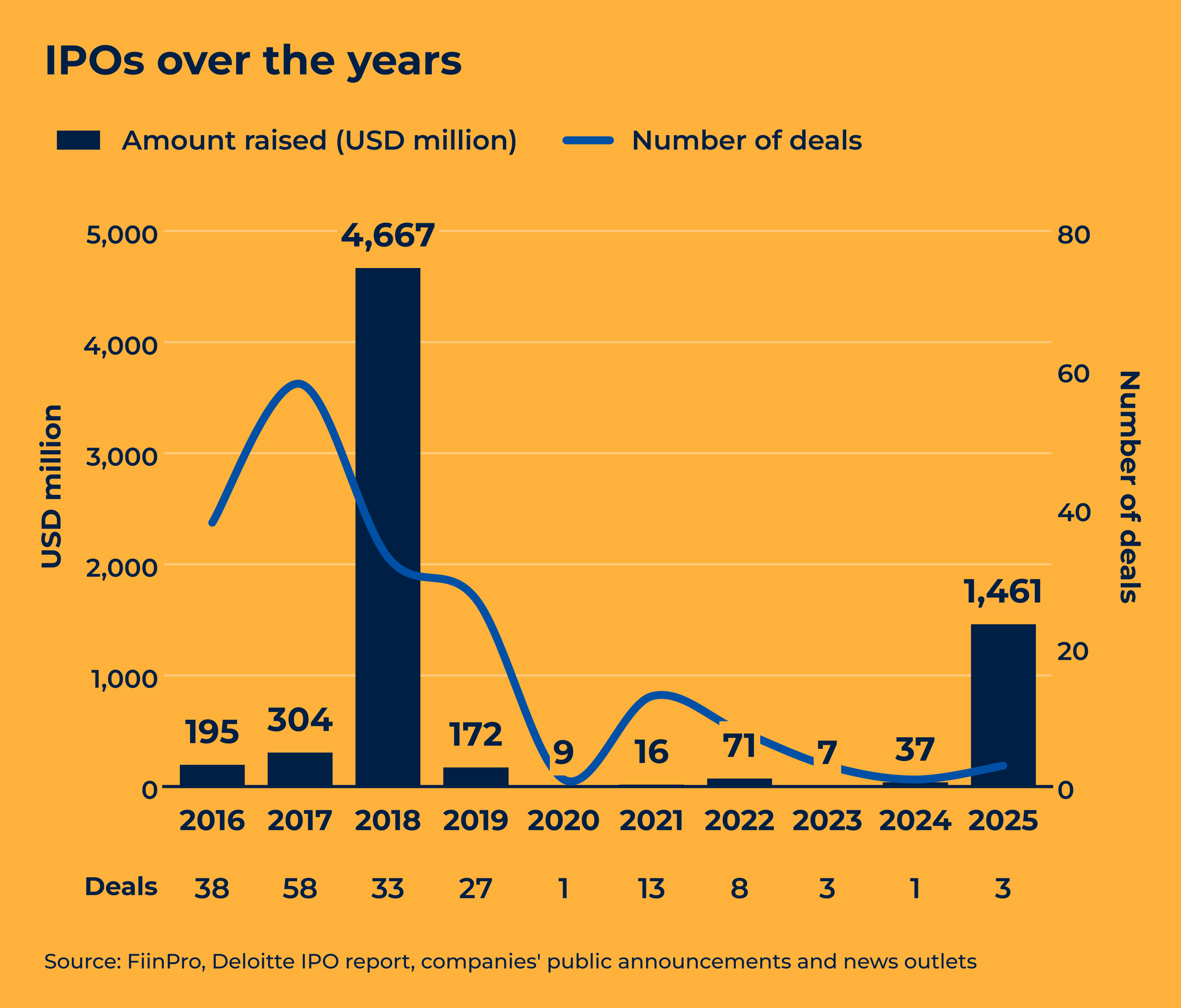
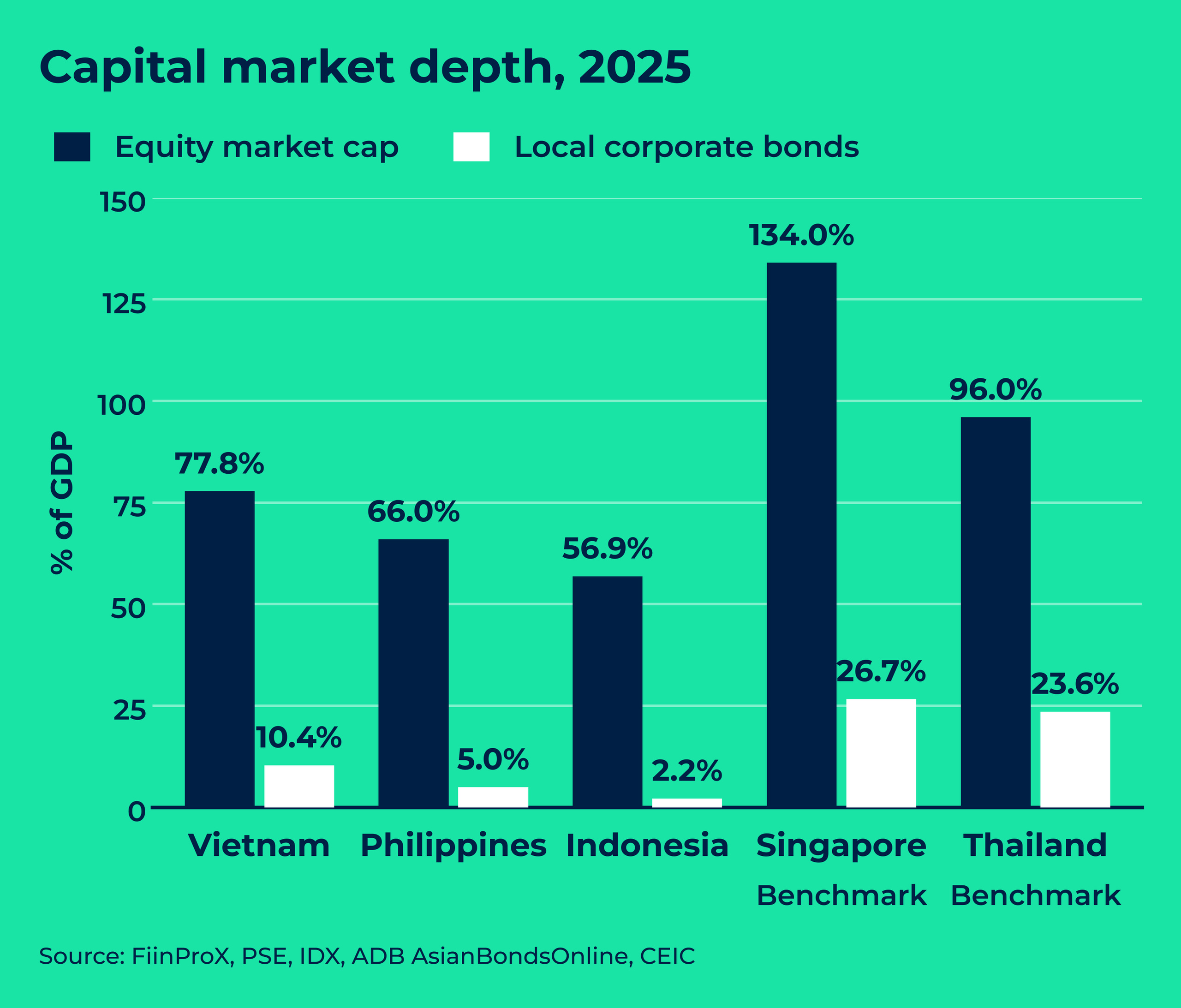
Vietnam’s capital markets have expanded rapidly in recent years, supported by strong retail participation and accommodative monetary conditions. Equity market capitalisation reached 77.8% of GDP in 2025 and daily trading value has surged 3.5× since 2020, with trading activity reaching the highest levels in ASEAN. However, the market remains heavily concentrated in banks and real estate, which together represent nearly 50% of market capitalisation and dominate trading activity, and the market is overwhelmingly retail-driven. IPO activity has been slow due to the limited pipeline of large private corporates and stalled SOE equitisation, although the market upgrade has helped revive the IPO pipeline. The corporate bond market has undergone significant restructuring following disruption in the real estate sector, and outstanding corporate debt remains concentrated in banking.
Investor Landscape
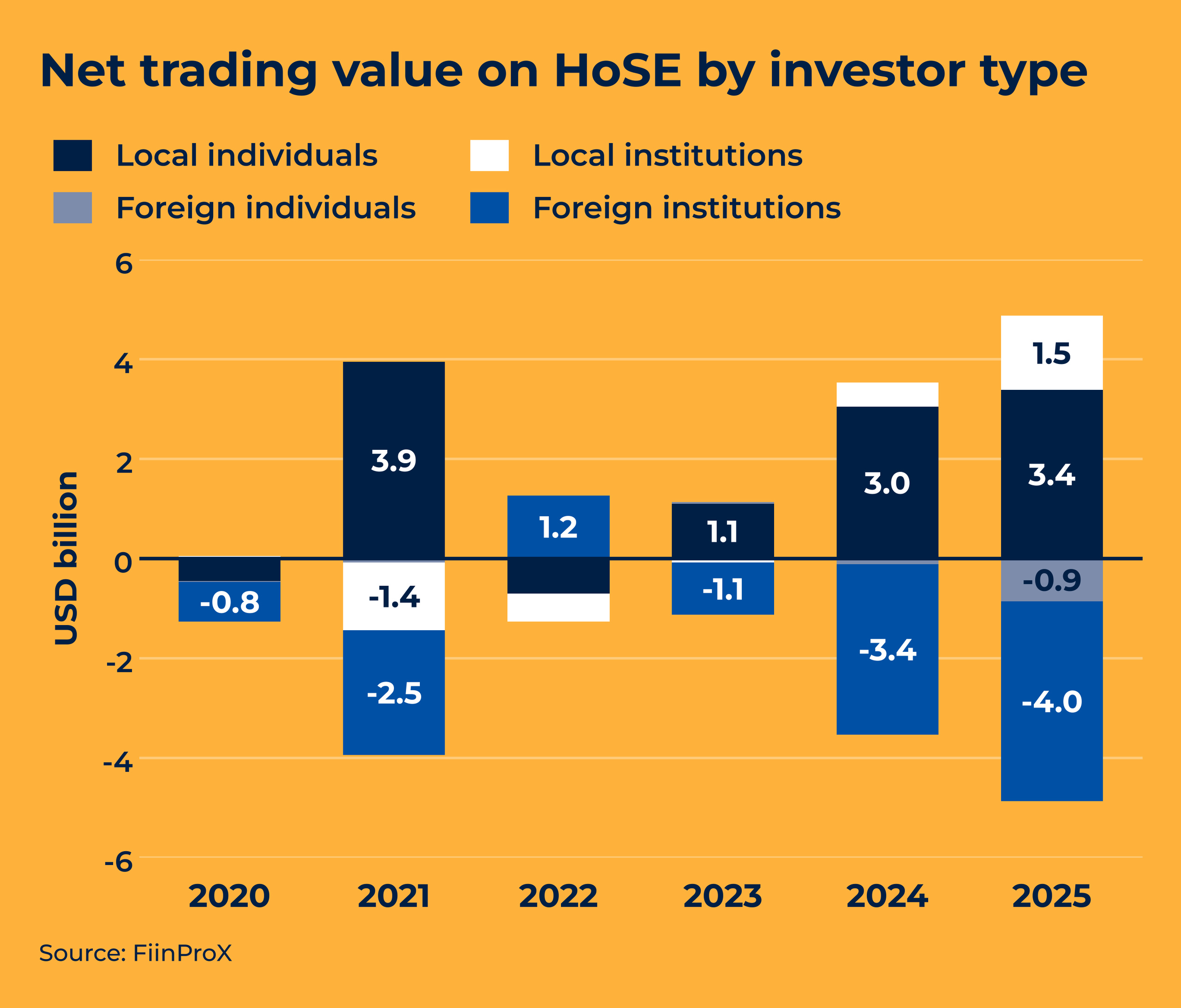
A broad retail investor base supports high levels of market activity, but institutional participation remains nascent. Vietnam Social Security and insurance companies, the largest domestic institutional investors, face strict limits on non-government securities, which will need to be addressed before they can serve as stable sources of corporate bond demand. Vietnam’s upgrade to FTSE Secondary Emerging Market status creates an opportunity to attract more institutional and foreign investment, but foreign ownership limits, uneven disclosure, market-access requirements and limited long-term foreign exchange hedging continue to constrain participation.
Intermediaries & Market Infrastructure
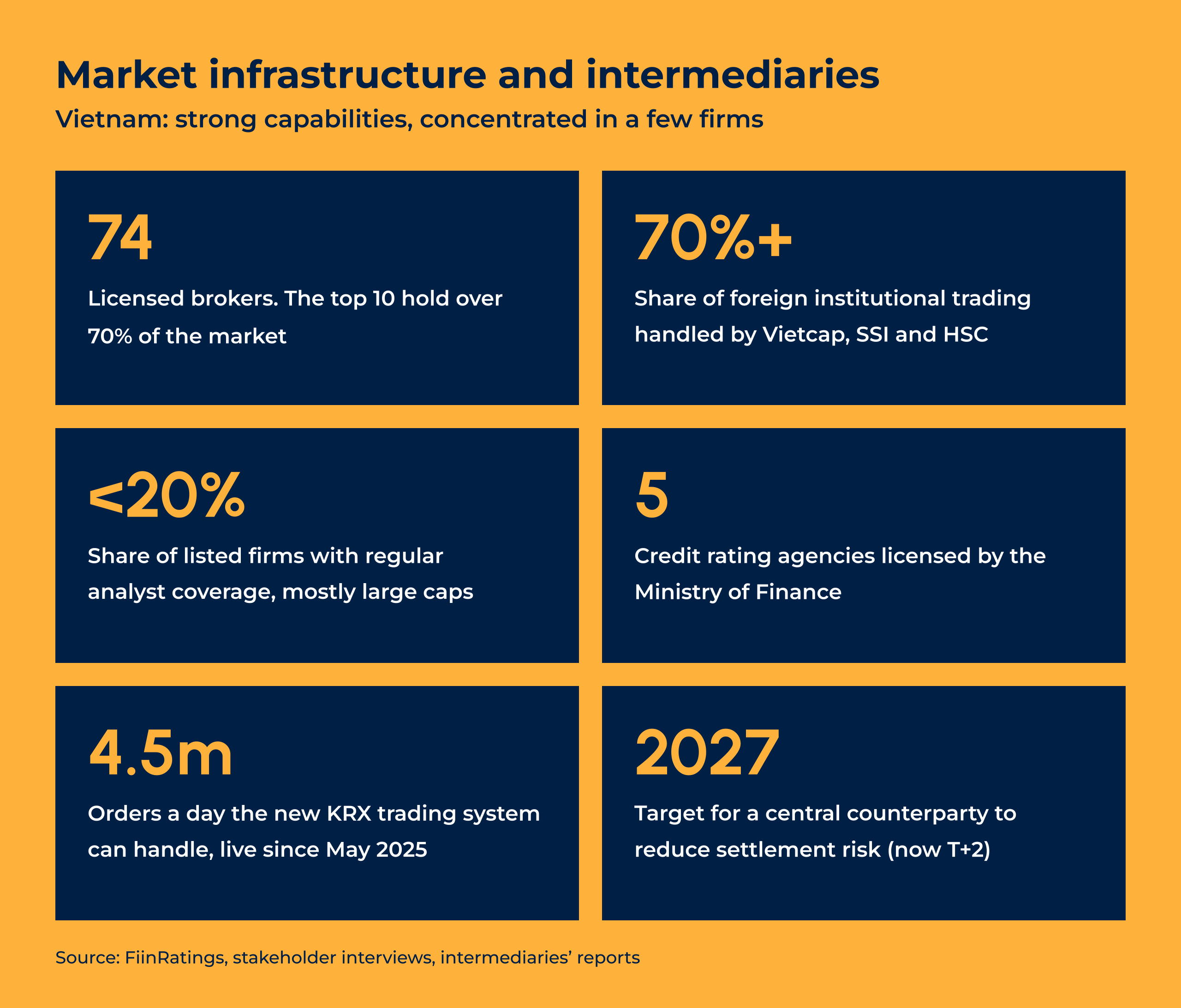
Vietnam’s leading securities firms have strong capabilities in research, underwriting and distribution, although these remain concentrated among a small number of firms. The KRX trading system and recent regulatory reforms have improved market access and trading capacity. Further progress is needed in central counterparty clearing (targeted for early 2027), English-language disclosure, credit rating coverage, institutional research and risk-management tools to support deeper participation and more efficient price discovery.
3.5×
Growth in daily equity trading value since 2020, to an average of USD 1.1 billion per day in 2025.
54.1%
Share of equity market trading value from retail investors in 2025, compared with 11.6% from foreign investors.
51.5%
Share of outstanding corporate bonds issued by credit institutions at end-2025. Real estate accounts for a further 28.9%.
Indonesia
Indonesia has the largest equity market of the three in absolute terms, although ownership concentration and a relatively low effective free float constrain market depth.

Market Landscape & Activity
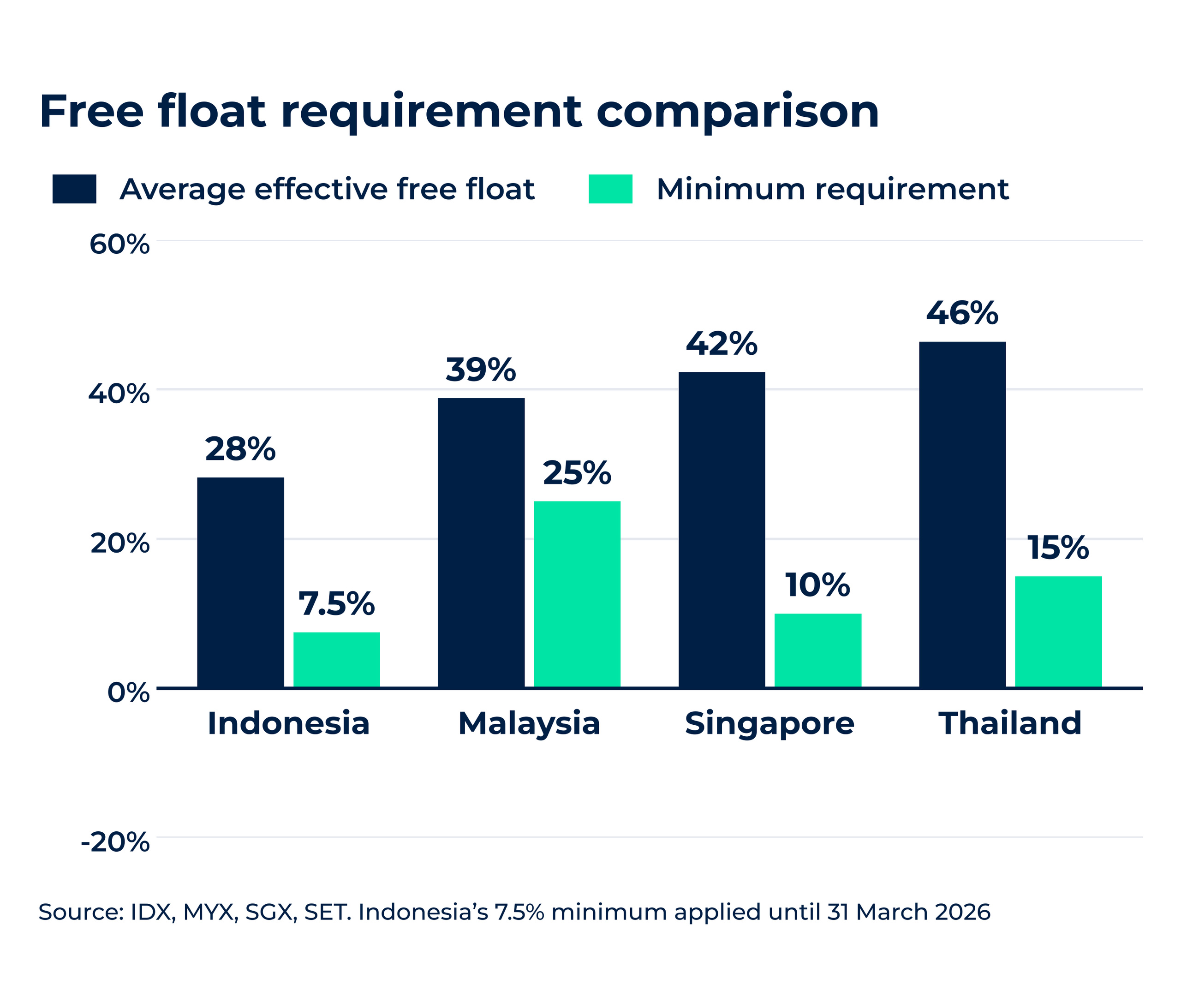
Indonesia has the largest equity market of the three countries in absolute terms and a broad listed-company base. Nevertheless, its financial system remains structurally centred on bank lending and government securities, with public markets playing a limited role in long-term corporate financing. Equity market capitalisation and liquidity are concentrated among large companies, state-owned enterprises and conglomerate-linked issuers, and the average free float is around 28%. Regulators are raising the minimum free float from 7.5%, previously the lowest among regional peers, to 15%, and strengthening ownership disclosure. More than 80% of outstanding bonds are government securities. The corporate bond market has expanded but remains modest in scale, concentrated among financial institutions and repeat issuers, and characterised by limited secondary market trading.
Investor Landscape
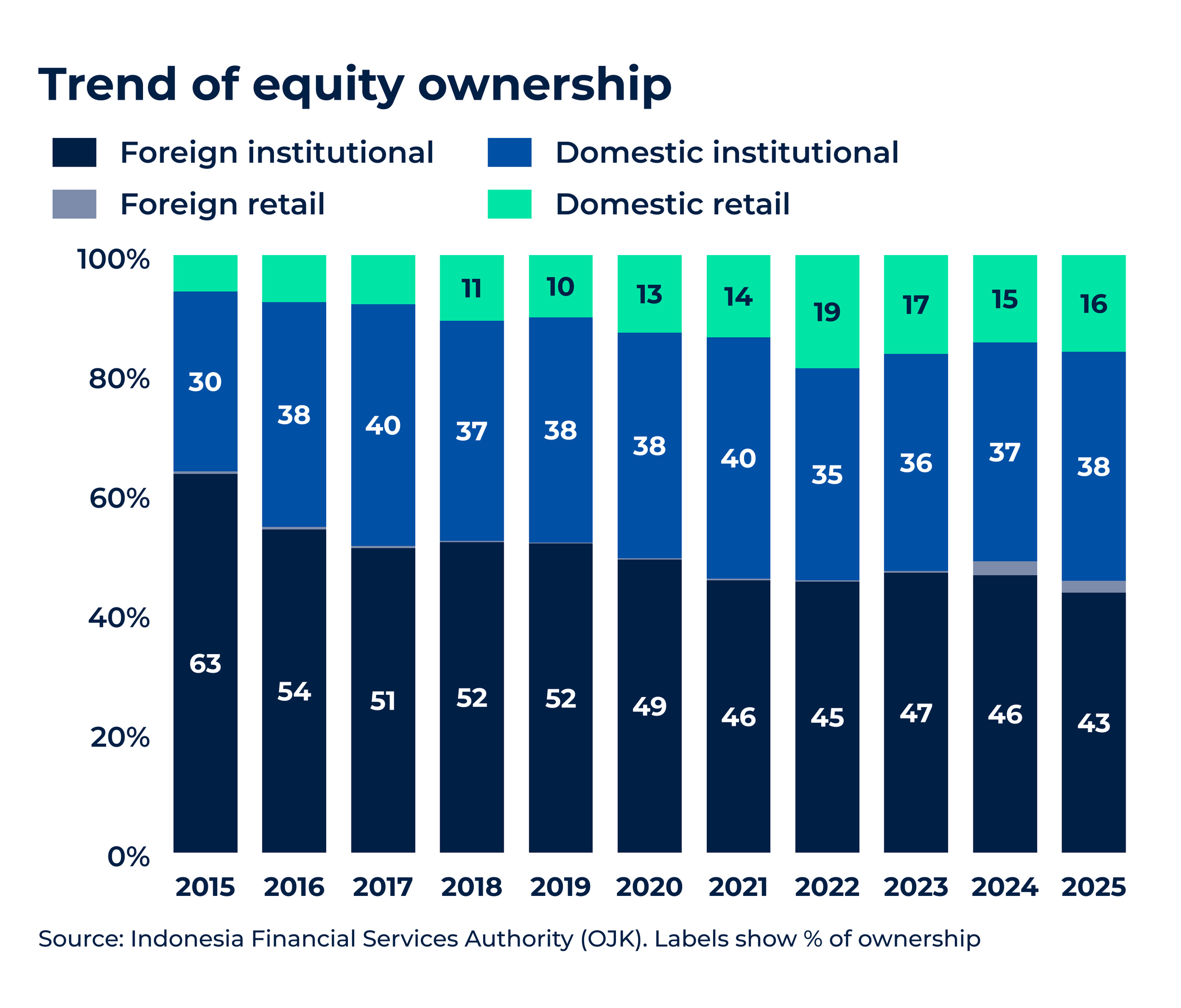
Indonesia has a comparatively developed domestic and foreign investor base, supported by growing retail participation and established institutional investors. However, pension and insurance assets remain small relative to GDP, while prudential rules and investment preferences continue to favour government securities and highly rated corporate bonds. Sustainable and transition finance has grown, but issuance remains concentrated among the sovereign, financial institutions and a small number of large corporate issuers.
Intermediaries & Market Infrastructure
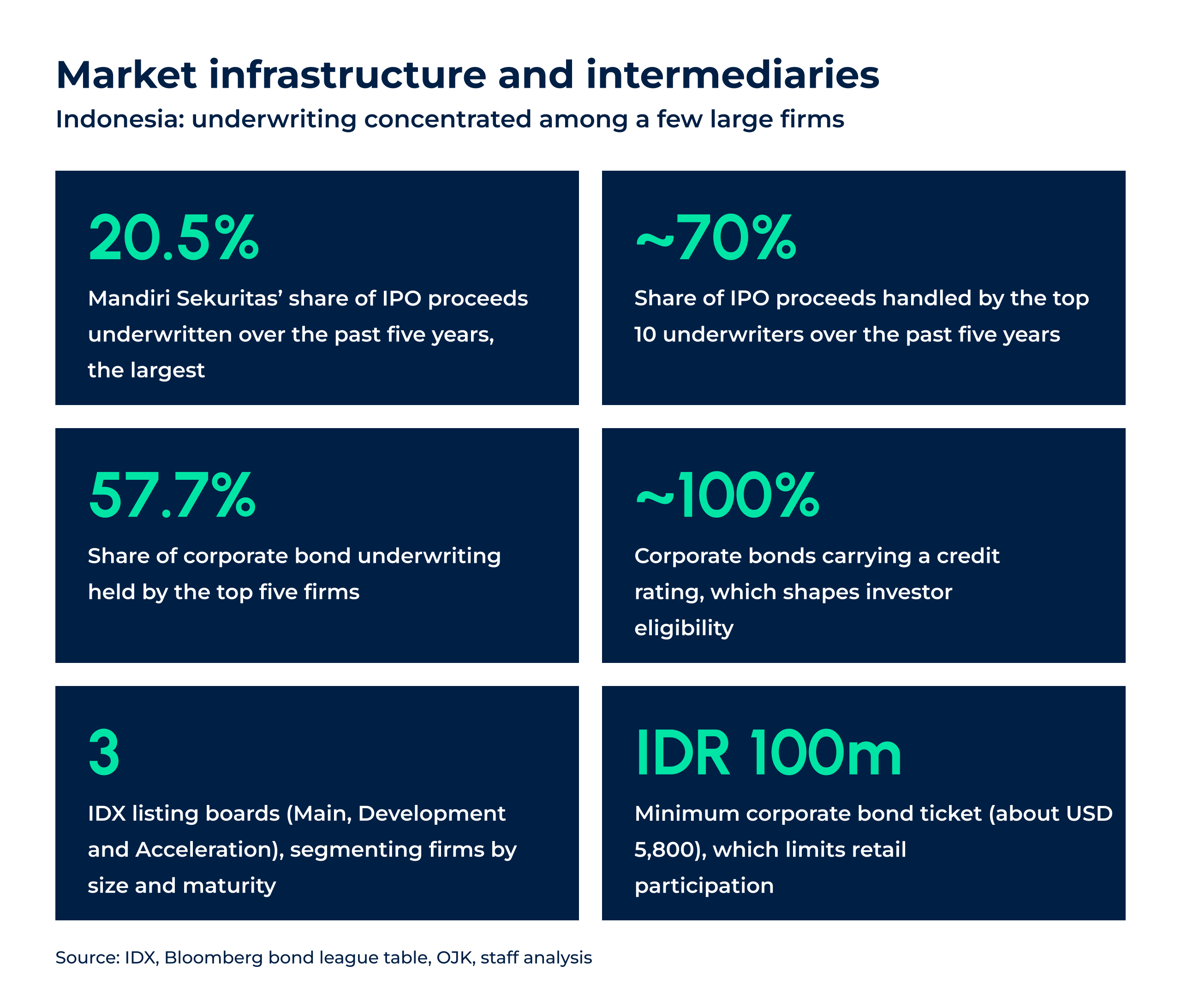
Indonesia has an established market architecture covering trading, clearing, settlement and securities depository functions, alongside strong digital infrastructure for retail participation. Leading intermediaries have substantial underwriting, distribution and research capabilities, although activity remains concentrated among a small number of large securities firms. In the corporate bond market, limited secondary trading, wide bid-ask spreads and buy-and-hold behaviour continue to restrict liquidity and price discovery, while research coverage remains weaker for small and mid-sized companies.
15%
New minimum free float for listed companies, up from 7.5%, to be met by 2027–2029. Compliance could require around USD 7.7 billion in additional public share issuance.
90%+
Share of corporate bonds held by domestic institutions (banks, insurers and pension funds). High minimum investment sizes (around USD 5,800) keep retail participation small.
80%+
Share of corporate bonds held by domestic institutions (banks, insurers and pension funds). High minimum investment sizes (around USD 5,800) keep retail participation small.
Common challenges across the region
Although the 3 markets are at different stages of development, they share several structural constraints.
The comparative diagnostic reveals sharp structural contrasts across the three focus countries and regional ASEAN benchmarks (Singapore and Thailand). While Vietnam leads in liquidity and market capitalisation relative to GDP, Indonesia and the Philippines face liquidity constraints and relatively underdeveloped corporate bond markets.
Bank-dominated financing
Bank loans remain the default source of corporate and infrastructure finance. This leaves capital markets as a secondary channel and concentrates risk on bank balance sheets.
A narrow institutional investor base
Pension funds, insurers and social security funds are constrained by investment mandates and capital rules that favour government bonds and deposits. As a result, they provide little demand for corporate bonds, new listings or long-term assets.
Concentrated issuers
Equity and bond markets are dominated by banks, real estate, state-owned enterprises and family conglomerates. Mid-sized companies and new sectors struggle to gain access.
Shallow secondary markets
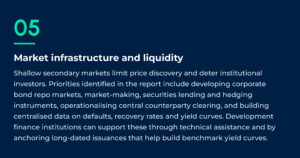
Buy-and-hold behaviour, limited market-making and missing tools such as repo, securities lending and hedging weaken liquidity and price discovery.
However, reform momentum is building. FTSE Russell’s upgrade of Vietnam to Secondary Emerging Market status (effective September 2026), Indonesia’s free-float and ownership-disclosure reforms, and the Philippines’ Capital Markets Efficiency Promotion Act, which reduces the stock transaction tax, signal a window in which coordinated, targeted support can help shift these markets towards greater depth and institutional maturity.
Actionable Recommendations for DFIs
Actionable interventions for development finance institutions should address structural constraints through catalytic mechanisms that strengthen market functions, not simply add capital. Credit enhancement remains a priority across all three markets, particularly through guarantee structures or direct co-investment vehicles that derisk lower-rated and first-time issuers in infrastructure andclimate-aligned sectors
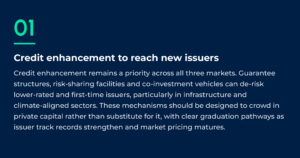
direct co-investment vehicles that derisk lower-rated and first-time issuers in infrastructure andclimate-aligned sectors. These mechanisms should be designed to crowd in private capital rather than substitute for it, with clear graduation pathways as issuer track records strengthen and market pricing mechanisms mature.