
Ex Post Evaluation of Financial Demonstration Effects

This report develops a scoring approach to evaluate the demonstration effects of development finance transactions: the follow-on financial activity by other organisations that replicate DFI transactions without the original DFI taking part. Commissioned by MOBILIST and produced by Risk Control, it presents an ex-post demonstration effect scorecard to measure demonstrations after a transaction has taken place. The report applies this scoring method to six innovative transactions and compares the results with the ex-ante scores these transactions received in an earlier study.
Why measure demonstration effects?
DFIs, both bilateral and multilateral, have long been expected to play a role that goes beyond providing capital to individual projects. Their broader development rationale is increasingly tied to the ability of their transactions to mobilise private finance, reduce market frictions, and support the growth of sectors, firms, and markets that might otherwise remain underfunded.
Development Finance through Public Markets: Originate-to-Demonstrate suggests that development finance transactions in listed markets can create durable public information streams about risks and returns in emerging and developing economies, helping to correct investor misperceptions and information asymmetries.
But while the concept is widely used, the way it is measured and evaluated has remained uneven. DFIs increasingly need to show not only whether a project was financed, but also whether it changed market behaviour, encouraged replication, or attracted later private capital. Yet, most do not publish a common retrospective framework for assessing such effects.
This report addresses that gap, moving beyond simple mobilisation counts toward a more complete assessment of whether DFI interventions generate durable market effects.
Evaluating demonstration effects before and after transactions
An earlier study by Risk Control, Innovative Deals in Development Finance: Originate to Demonstrate, developed the notion of financial demonstration effects and described how they were reflected in a set of innovative transactions.
To make the analysis of such effects operational, it proposed an ex-ante scoring approach which a DFI could use to rank different transactions for the degree to which they could be expected to generate financing volumes through demonstration effects. This included an ex-ante scorecard designed to assess, before a transaction is committed, whether it is likely to generate a strong demonstration effect.
This report develops a complementary ex-post approach in which transactions are assessed based on the degree to which they create follow-on development finance activity. Where ex-ante scoring is forward-looking and aims to predict likely follow-on activity, ex-post scoring uses observed evidence to measure the scale and pace of replication, and the quality and credibility of the resulting market effects.

The ex-post evaluation framework
The ex-post scorecard consists of a structured decision tree that combines quantitative and qualitative elements. A time window opens when a transaction closes. After eight years, the window closes, and a definitive demonstration effect score is determined. The final score is in the range of zero (very weak) to five (extremely strong).

Financing Effects
Analysis of financing deal volume is based on ‘follow-on’ deals. These are transactions in which the original transactor is not involved. The transactions must also mimic the original transaction by including its innovative deal characteristics, such as the same structure/mechanism, same target asset class, or same use-of-proceeds logic. Transactions that bear a less direct relation to the original deal may be assigned to the category of ‘neighbourhood deals’.
Causality
The assessment rests on a counterfactual judgement: in the absence of the reference transaction, would the market have developed the same interest in, and capacity for, the innovative structure? A ‘High’ rating applies where the transaction plausibly unlocked a market that would otherwise have remained dormant or significantly delayed. A ‘Low’ rating applies where the market was already moving toward the innovation, such that the transaction accelerated rather than caused it. The resulting discount ensures that observed follow-on volumes are attributed to the reference transaction only to the extent that a credible causal link can be established.
Quality Effects
Demonstration-effect scoring should weight replication by where it occurs: follow-on activity in lower-income markets delivers greater development value than the same volume confined to high-income markets. The development quality dimension is based on the per capita income levels of countries directly affected, countries affected by follow-ons, and countries affected by neighbourhood transactions. The quality of risk mobilisation is also assessed.
Awareness Effects
Market awareness is so central to scaling and reinforcing transaction volumes that it should factor directly into the demonstration effect scoring. The indicators are references in specialist publications, industry awards/recognition, recognition in rating agency treatments, and public market visibility for listed securities.
References in specialist publications are collected using a purpose-built AI-powered sentiment analysis tool developed by Risk Control. The tool processes research papers, industry reports, regulatory publications, press releases, and opinion pieces, and classifies each document according to its expressed stance toward the reference transaction. Documents issued by the transaction entity are reported separately in order to distinguish independent commentary from issuer-generated material. The tool will be provided to FCDO and other DFIs on an open-source basis.
Facilitation
The market environment over the assessment window, termed facilitation, is classified as “Favourable”, “Neutral”, or “Unfavourable”. The indicators used include issuance conditions and market risk appetite proxies relevant to the asset class.
Case study evaluations
The ex-post scorecard was applied to six transactions first studied in the earlier Originate to Demonstrate report. The selected transactions were all considered, on an ex-ante basis, to have the potential to generate positive demonstration effects within their respective markets. They cover a diverse range of financing structures and sectors, and include two transactions undertaken entirely by private-sector institutions.
Comparing the ex-ante and ex-post scores allows an assessment of whether the ex-ante scoring approach reliably predicts ex-post demonstration effect outcomes, and where the largest divergences between predicted and realised effects have occurred.
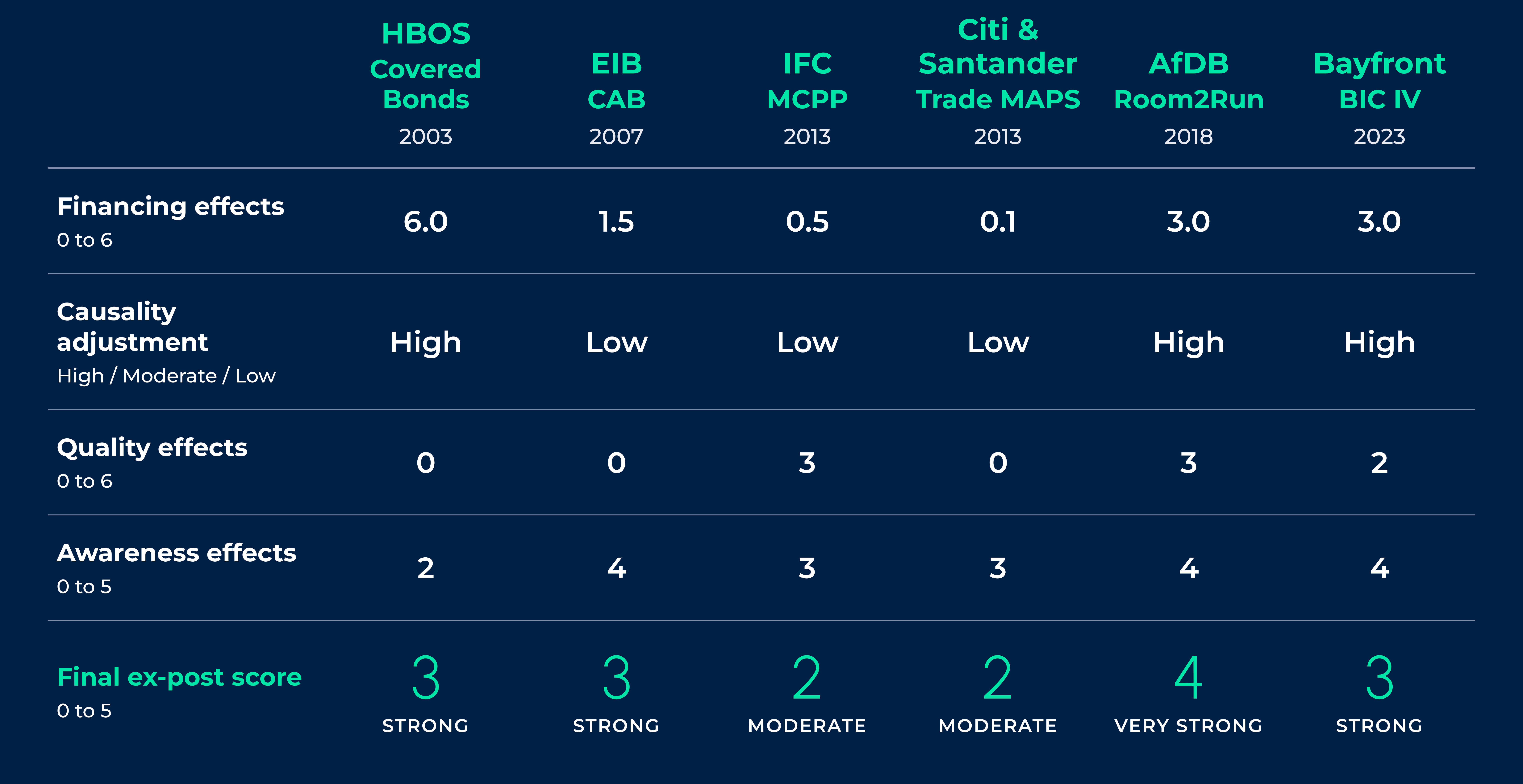
HBOS Structured Covered Bonds (2003)
In July 2003, HBOS Treasury Services plc issued the first covered bonds in the UK and also the first covered bond issuance without a dedicated covered bond law. The transaction showed that covered bond structures could be created in jurisdictions without a specific legislative regime.
In the United Kingdom, issuance growth began prior to the introduction of legislation, particularly in the period from 2003 to 2008 following the pioneering HBOS transaction. Similar pre-regulatory market development can be observed in France and the Netherlands, suggesting that market innovation initially preceded regulation. In the absence of HBOS, the introduction of covered bonds into the market would likely have been substantially delayed. The programme was issued in a high-income country, and the majority of market perceptions were neutral.
EIB Climate Awareness Bond (2007)
In May 2007, the European Investment Bank launched the first worldwide green bond, known as the Climate Awareness Bond. Its design combined environmental purpose with mainstream bond-market features, which helped demonstrate that capital markets could be used to raise funds for climate-related investment on a large scale.
Although ProCredit Holding AG technically issued the first green bond (€25 million) seventeen days earlier, the EIB’s €600 million issue suggests that a substantial initial issuance may be important in achieving a strong demonstration effect. Interest in green bonds has since expanded beyond DFIs, with non-DFI entities now surpassing DFIs in total issuance. However, green bonds would likely have emerged by around 2012 even without the benchmark issuance. Borrowers were concentrated in high-income countries, and market sentiment was predominantly supportive.
IFC Managed Co-Lending Portfolio Program (2013)
In 2013, IFC launched its Managed Co-Lending Portfolio Program (MCPP) with a US$3 billion trust fund mandate from SAFE of the People’s Bank of China. By the end of FY2025, the investor pool had increased to $19.2 billion, and the programme had allocated $14.4 billion across 371 projects in 72 countries.
No comparable structure to IFC’s MCPP was identified. The score was constrained by the relatively less transparent structure and the absence of comparable platform structures subsequently developed by other DFIs. The weighted average income classification of borrowing countries is upper middle income, and market sentiment was predominantly supportive.
Trade MAPS (2013)
In December 2013, Citigroup and Santander launched Trade MAPS 1 Limited, a multi-seller securitisation platform for global short-term trade finance loans. The platform was designed as a blueprint that could later be used by other global trade finance banks.
However, no subsequent transactions were identified following the initial issuance, and there is limited evidence to suggest a significant demonstration effect within this asset class. Market discussion was concentrated in 2013 and 2014, suggesting that the transaction did not achieve sustained market traction, potentially due to limited follow-on activity, insufficient market promotion, or concerns regarding the long-term viability of the structure.
AfDB Room2Run (2018)
In 2018, the African Development Bank (AfDB) completed Room2Run, a synthetic securitisation of a US$1 billion portfolio of existing loans. It is often cited not simply as a financing deal, but as a case study in MDB portfolio risk transfer and capital optimisation.
AfDB followed with a US$2 billion Room2Run sovereign obligor transaction in 2022, and three other MDBs – BOAD, IDB Invest and IFC – also issued securitisation transactions. This suggests a growing willingness among MDBs to securitise portions of their portfolios as a means of enhancing capital efficiency and expanding lending capacity. Room2Run received the highest score, reflecting its success in generating follow-on transactions and providing a replicable template for similar structures in the market. Borrowers were concentrated in lower-middle income countries, and the transaction performed strongly in the awareness category, supported by industry recognition and positive market perception.
Bayfront Infrastructure Capital IV (2023)
In September 2023, Bayfront Infrastructure Management priced Bayfront Infrastructure Capital IV (BIC IV), the fourth issuance under its infrastructure asset-backed securities platform, for US$410.3 million. BIC IV was a landmark issuance because MOBILIST committed up to US$20.4 million to the equity tranche, marking the first time the platform involved a third-party equity investor.
Issuance volume increased significantly in 2025, with BIC VI and BIC VII together totalling $1,232 million. The Hong Kong Mortgage Corporation’s Bauhinia ILBS platform represents a successful replication of the BIC transaction model in a distinct institutional and regulatory context. BIC IV is the only case study with a partial demonstration effect, as its full effects have yet to be observed. This presents FCDO with a distinct opportunity to strengthen the deal’s demonstration effects by supporting consistent growth in issuance volumes, advocating for a portfolio weighted towards a greater proportion of low- and middle-income countries, and funding independent studies, since 20 of the 30 documents identified were published by Bayfront.
Ex-ante scores tend to be higher than the corresponding ex-post scores.
Demonstration effects can substantially magnify the impact of development finance interventions by DFIs. Unlike private sector financial institutions, which benefit from restricting replication of their own innovations, DFIs seek to encourage follow-on transactions to mobilise as much private-sector financing as possible.
The results show a positive correlation between ex-ante and ex-post scores. However, ex-ante scores tend to be higher than the corresponding ex-post scores, suggesting that ex-ante assessments may incorporate optimistic assumptions. By contrast, ex-post scores are based on realised outcomes and observable market evidence, which provide a more grounded assessment of the actual demonstration effects achieved over time.
The most direct remedy is to bring the counterfactual reasoning of the ex-post causality adjustment into the ex-ante stage, asking explicitly at the point of investment whether the innovation would likely emerge without the transaction. The ex-ante score should also be treated as provisional, with intermediate review points within the eight-year window allowing optimistic assumptions to be corrected progressively against early follow-on evidence.
Read the original Risk Control study on evaluating demonstration effects before a transaction takes place.